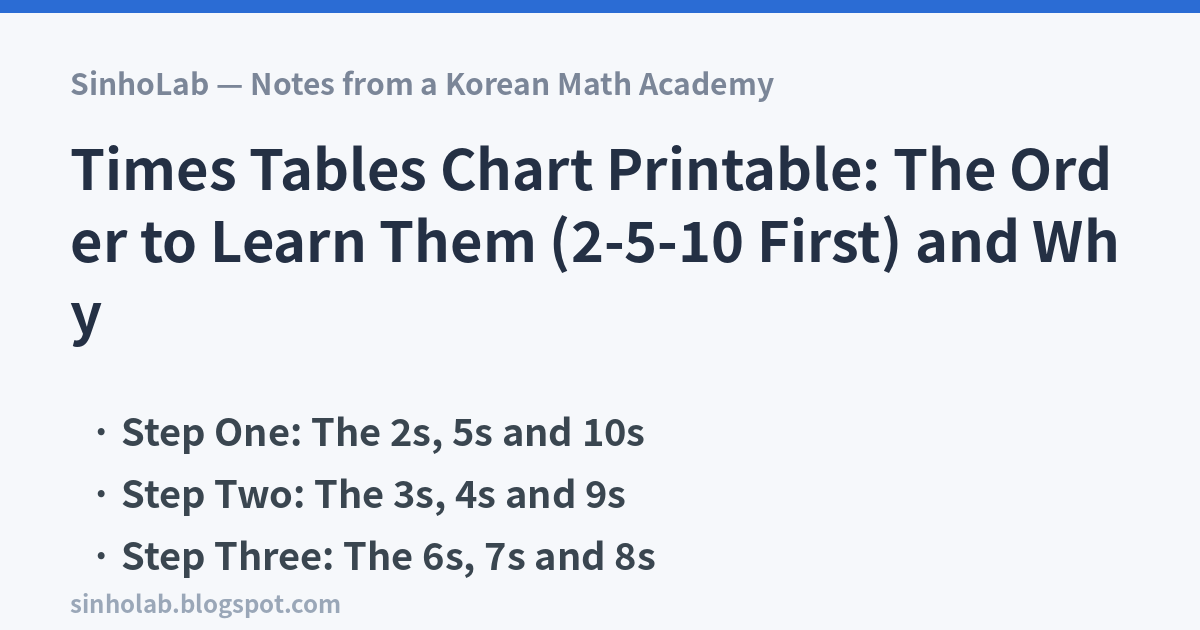
Times Tables Chart Printable: The Order to Learn Them (2-5-10 First) and Why
If you've ever taped a times tables chart to the fridge and watched your child stare at it like it's a wall of random numbers, you're not alone. A full 10×10 or 12×12 grid is a lot to take in at once. The good news is that nobody has to learn it all at once, and the order your child learns the tables in makes a real difference.
I run a math academy in Korea, where children learn their times tables (we call it gugudan) in second grade. Over the years I've seen many kids learn their tables. The ones who do best usually aren't the ones who drilled the hardest. They're the ones who learned the tables in a sensible order, with each new table building on the last. Here's the order I recommend, why it works, and how to use a printable chart without it turning into a chore.
Why the Order Matters More Than You'd Think
Most children meet the times tables in order: 1s, 2s, 3s, 4s, and on up. It looks tidy on paper, but it's not the easiest way to learn. The 3s come before the 5s, even though the 5s are much easier for most kids. The 7s land in the middle, even though they're usually the hardest set of all.
A better approach is to start with the tables that have obvious patterns, then use those to unlock the harder ones. Children who start with easy wins build confidence early. Confidence counts for a lot here, because a child who believes "I'm good at this" will keep practicing, and a child who feels stuck on the 3s by week two often won't.
There's also a simple bit of math that helps. Multiplication is commutative, so 3 × 5 gives the same answer as 5 × 3. Every fact your child learns covers two spots on the chart. So once the 2s, 5s and 10s are solid, a good chunk of the chart is already done, including 7 × 5, 8 × 2 and 9 × 10.
Step One: The 2s, 5s and 10s
These three tables go first because children already know most of them without realizing it.
- The 10s are the easiest pattern: add a zero. 4 × 10 = 40, 7 × 10 = 70. Children who can count by tens already know this table.
- The 2s are just doubling. Kids double things all the time ("I want two cookies, and my sister wants the same"), and counting by twos is often something they've done since kindergarten.
- The 5s tie in with telling time on a clock and counting nickels (in the US). The answers always end in 5 or 0, which gives kids a built-in way to check their work.
Spend real time here. Being able to skip-count out loud isn't the goal. You want your child to answer "6 × 5?" in a couple of seconds, without counting up from the beginning. That kind of instant recall is what makes later math, like long division and fractions, so much smoother.
Step Two: The 3s, 4s and 9s
Once the first three tables feel easy, move on to tables that can lean on them.
- The 4s are the 2s doubled. If your child knows 6 × 2 = 12, then 6 × 4 is just 12 doubled, which is 24. Teaching this link directly ("double it, then double it again") turns a new table into an extension of an old one.
- The 3s don't have a trick as neat as the others, but skip-counting by threes (3, 6, 9, 12, 15...) comes fairly easily with a bit of rhythm. It also helps to notice that 3 × a number is "double it, plus one more," so 3 × 7 = 14 + 7 = 21.
- The 9s are full of patterns kids love. For the first ten facts, the tens digit goes up by one while the ones digit goes down by one (09, 18, 27, 36...), and the two digits always add up to 9. There's also the famous finger trick: hold up ten fingers, fold down the one matching the number you're multiplying by 9, and read the fingers on each side as tens and ones. You can also think of 9 × a number as 10 × that number minus one group, so 9 × 6 = 60 − 6 = 54.
At this stage, children often feel like they're "getting it." That feeling is worth protecting. Praise the strategies they use ("You doubled the 2s, smart!"), not only right answers.
Step Three: The 6s, 7s and 8s
These are the tables most children find hardest, and for good reason: there's no single simple pattern. But by this point, most of their facts are already covered from earlier tables.
Here's the part parents are often surprised by. If your child knows the 1s, 2s, 3s, 4s, 5s, 9s and 10s, then within the 10×10 grid the only facts left to learn are the ones where both numbers are 6, 7 or 8. There are just six of them:
- 6 × 6 = 36
- 6 × 7 = 42
- 6 × 8 = 48
- 7 × 7 = 49
- 7 × 8 = 56
- 8 × 8 = 64
That's a lot less scary than "learn the 7 times table." Some helpful bridges:
- The 6s: 6 × a number = 5 × that number, plus one more group. So 6 × 7 = 35 + 7 = 42.
- The 8s: double, double, double. 8 × 7: 7 → 14 → 28 → 56.
- The 7s: many children simply memorize the few that are left. A classic memory hook is "5, 6, 7, 8": 56 = 7 × 8.
If your school goes up to 12 (in England, for example, children are expected to know their tables up to 12 × 12 by the end of Year 4), the 11s and 12s can come last. The 11s up to 9 × 11 are just the digit repeated (33, 44, 55...), and the 12s are 10 × a number plus 2 × that number.
The Learning Order at a Glance
Here's the whole plan in one place. You might want to print this out alongside your chart.
| Stage | Tables | Main strategy | What it builds on |
|---|---|---|---|
| 1 | 2s, 5s, 10s | Skip-counting, doubling, adding a zero | Counting, money, clock faces |
| 2 | 4s, 3s, 9s | Double the 2s; "double plus one more"; 10s minus one group | 2s and 10s |
| 3 | 6s, 8s | 5s plus one group; double three times | 5s, 2s, 4s |
| 4 | 7s | Memorize the few remaining facts (7×7, 7×8) | Everything above |
| 5 (if needed) | 11s, 12s | Repeated digits; 10s plus 2s | 10s and 2s |
How to Use a Printable Times Tables Chart Well
A chart works best as a reference and a way to see progress. It isn't meant to be something your child stares at until the numbers stick. Here are a few ways to get more out of one:
- Color in what's mastered. Give your child a highlighter. Each time they know a fact instantly on three different days, they color that square. Watching the grid fill up is motivating, and because of commutativity, one fact often colors two squares.
- Look for patterns together. Ask, "What do you notice about the 5s column?" or "Why are the numbers on the diagonal special?" (Those are the square numbers: 1, 4, 9, 16, 25...) Kids remember what they discover for themselves much better than what they're told.
- Cover part of it. Once a table feels solid, fold or cover that row and practice from memory. Uncover it only to check answers.
- Keep sessions short. Five to ten minutes a day beats an hour on Sunday. Short, frequent practice is what builds fast recall.
- Pair it with written drills. The chart is for looking things up, while a short worksheet is for retrieval practice. Retrieval, pulling the answer out of memory, is what actually makes facts stick.
What We Do Differently in Korea (and What You Can Borrow)
In Korea, children usually learn gugudan in second grade, covering the 2s through the 9s. Many families also have kids recite the tables out loud in a sing-song rhythm: "i-il-eun-i, i-i-sa" ("two ones are two, two twos are four"). It sounds old-fashioned, but the rhythm really does help. Children often know the 2s through the 9s by heart before the school year is done.
Chanting alone isn't enough, though. The part I'd suggest borrowing is the daily habit of short written practice. Many Korean kids do one small page of arithmetic a day, usually 20 to 30 problems. It only takes a few minutes, but because it happens every day, the facts become automatic. That same small-but-daily pattern works just as well for any child, anywhere.
One more tip from the classroom: when a child gets a fact wrong, don't just give the answer. Ask, "What do you already know that's close?" If they're stuck on 6 × 8, can they find 5 × 8 = 40 and add one more 8? This turns every mistake into practice with a strategy, not a small moment of failure.
Signs Your Child Is Ready to Move On
It's tempting to rush ahead, especially if the school is moving quickly. Here's a simple check before moving to the next stage:
- They can answer mixed-up facts from the current stage (not just in order) in about two or three seconds each.
- They don't need to count on their fingers or skip-count from the start.
- They still remember the facts after a day or two off.
If they aren't there yet, that's completely fine. Spend a few more days on the current stage. The time you spend getting the 2s, 5s and 10s solid pays off later, because every harder table builds on them.
Times tables don't have to be a battle. Learn them in a smart order, keep practice short and regular, and celebrate progress on the chart. Most children get there sooner than their parents expect.
If you'd like ready-made practice sheets to go with your chart, you can print free Korean-style math drills in English at mathsignal.co.kr/sheet/en. They're short daily pages, the same kind many Korean kids use.

댓글
댓글 쓰기