Day Master Saju: How to Find Your 1 of 10 Stems in 4 Steps

Your Day Master Is the Top Character of Your Day Pillar
Your Day Master is a single Chinese character, and it is one of only 10. Saju, also called Four Pillars or BaZi, describes a birth with four pillars: year, month, day and hour. Each pillar has two characters. The top one is a "heavenly stem" and the bottom one is an "earthly branch". Four pillars with two characters each make 4 × 2 = 8 characters in all, which is why the system is also called "eight characters".
Your Day Master is the stem of the day pillar, meaning the top character of that pillar. In a Saju reading it stands for you, and the other seven characters are read in relation to it. So finding it means working out one character, not all eight.
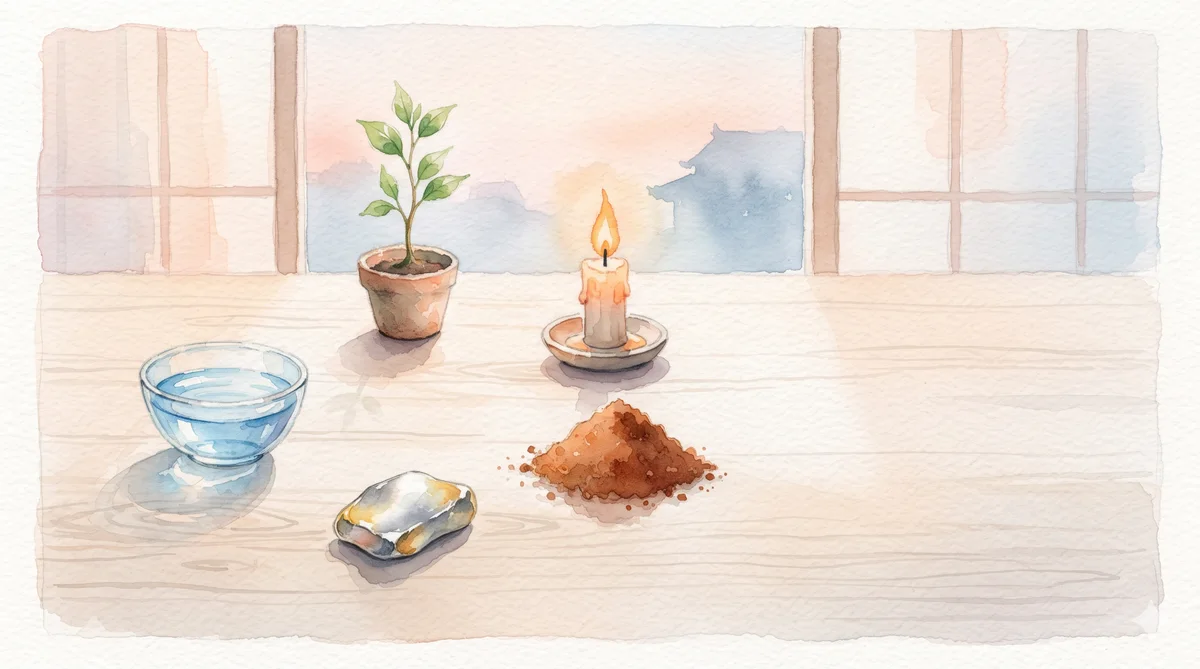
The 10 stems come from 5 elements: Wood, Fire, Earth, Metal and Water. Each element has a Yang form and a Yin form, and 5 × 2 = 10. Your Day Master therefore has only 10 possible answers. The next section shows how to narrow them to one with simple arithmetic and a calendar.
How to Find Your Day Master by Hand
Ten stems paired with twelve branches give 60 combinations, and days are named by running through those 60 in order. Eclipse records show the day count has run without a break since the Spring and Autumn period (722–481 BCE). Because there are 10 stems, the stem part repeats on a 10-day loop, and that loop is all you need. You only need an anchor date and a numbered stem list.
The anchor is January 1, 2000, which was a Mu (戊) Earth day. As a cross-check, it is the Mu-O (戊午) day, which is number 54 in the 60-day cycle. Counting from the official reference day of October 1, 1949, a Gap-Ja (甲子) day, 18,354 days pass before January 1, 2000, and 18,354 mod 60 = 54, which matches. Now number the stems from 0: Gap 0, Eul 1, Byeong 2, Jeong 3, Mu 4, Gi 5, Gyeong 6, Sin 7, Im 8, Gye 9. Mu sits at position 4, which is why the formula adds 4.
1. Count the days from January 1, 2000 to your birth date. Leap days count.
2. Add 4.
3. Divide by 10 and keep the remainder.
4. Look up that remainder in the numbered stem list above.
Here is a worked example for May 15, 2010 (solar calendar, born in daytime). January 1, 2000 to January 1, 2010 is 3,653 days, because 2000, 2004 and 2008 were leap years. January 1 to May 15, 2010 is 31 + 28 + 31 + 30 + 14 = 134 days. The total is 3,653 + 134 = 3,787 days. Add 4 to get 3,791. The remainder of 3,791 ÷ 10 is 1, and position 1 is Eul (乙), Yin Wood. The full day pillar for that date is Eul-Chuk (乙丑), but only the top character is the Day Master.
For a birth before 2000, count the days back from your birth date to January 1, 2000 instead. Subtract that count from 4, then add 10 until the number falls between 0 and 9.
The clock can move your result by one stem. The Chinese national standard for stem-branch dates runs each day from 0:00 to 24:00 Beijing time (UTC+8). It does not turn over at 23:00. Korea runs on UTC+9, one hour ahead, so a baby born between 0:00 and 1:00 Korean time may land on a different day depending on which clock a calculator uses. The "Ja hour" runs from 23:00 to 01:00, and whether your school changes the day at 23:00 or at 0:00 needs checking. If you were born between 11 p.m. and 1 a.m., calculate both ways and keep both answers in mind.
You can check your math against the public lunisolar calendar data of the Korea Astronomy and Space Science Institute, which returns the day's stem-branch for a solar date you enter. Take October 22, 2026. It is 9,791 days after January 1, 2000, and 9,791 plus 4 is 9,795. The remainder after dividing by 10 is 5, which is Gi (Yin Earth). The branch is Sa, so the day pillar is Gi-Sa (己巳), and a published Korean day-pillar listing gives the same result for that date.
The 10 Day Masters at a Glance
The table below uses the images a classical Saju text gives each stem. Read it as traditional symbolism, not as a personality test.
| Element | Yang Day Master | Yin Day Master | Classical image (Yang / Yin) |
|---|---|---|---|
| Wood | 甲 Gap | 乙 Eul | A tree reaching the sky / a soft vine |
| Fire | 丙 Byeong | 丁 Jeong | A fierce blaze / soft at its core |
| Earth | 戊 Mu | 己 Gi | Solid, heavy earth / low, damp earth |
| Metal | 庚 Gyeong | 辛 Sin | The firmest metal / soft, lustrous, clear metal |
| Water | 壬 Im | 癸 Gye | Vast, wide water / the weakest water |
Yang and Yin differ in form. Yang Wood is the tall tree reaching the sky, and Yin Wood is a soft vine that wraps around the tall tree. Both are Wood, but the tradition pictures one as standing upright and the other as clinging and flexible. Gyeong (庚) is read as the hardest metal, while Sin (辛) is read as soft, lustrous and clear.
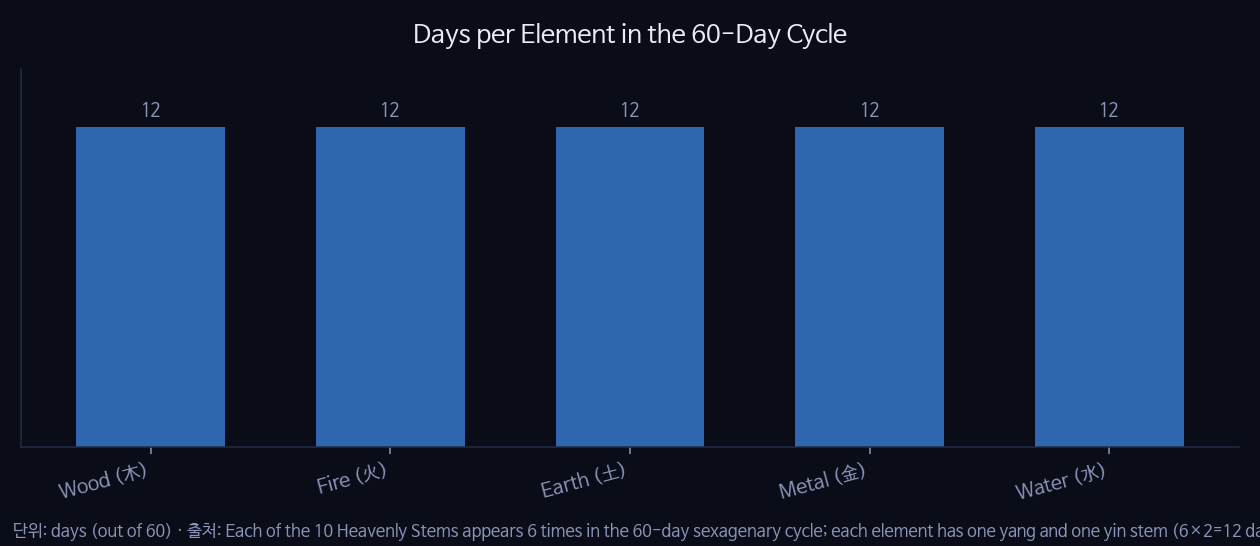
No Day Master is rarer than another. In the 60-day cycle each of the 10 stems appears exactly 6 times, so each one covers 10% of days.
Reading Your Day Master Without Overreading It
A Day Master is one character out of eight. Saju interpretation looks at how the five elements balance across the whole chart, and at which elements are plentiful, thin or missing. The Day Master is the reference point for that reading, but it is not the whole reading. Two people with Eul as their Day Master can have very different charts once the other seven characters are in place. For the same reason, a Day Master is a poor basis for labeling a child or for choosing a school, a career or a health plan.
Signal Lab, a site that offers Korean four-pillars fortune readings in English along with reaction and memory games, is another place to compare your result. If the reading shows your day pillar, compare its top character with your hand calculation. If the two match, you have your Day Master. If they differ by one stem, recheck the birth time and the time zone you used. The games are separate from the reading, and your scores say nothing about your Day Master.
Related free tool: Signal Lab — K-Saju fortune & brain games

댓글
댓글 쓰기