Five Elements Saju: How to Count Your 8 Characters
Your Strongest Element Sets the Tone
Count the 8 characters in your chart and note which element shows up most. That element has the largest share of your chart. An element at 0 does not appear in any of the 8 characters.
Saju (四柱) means "four pillars." The pillars are the year, month, day, and hour of your birth. The name comes from a house, with each of the four pillars holding up the structure. Each pillar is written with 2 characters, so a full chart has 4 × 2 = 8 characters. That is why saju is also called palja (八字), "eight characters."
The two characters in a pillar come from two different lists. One is one of 10 heavenly stems. The other is one of 12 earthly branches. Every stem and every branch belongs to one of five elements: Wood, Fire, Earth, Metal, or Water. So each of your 8 characters carries one element, and counting them is simple arithmetic.
The Five Elements and the Traits Linked to Each
The link between element and character traces back to the five Confucian virtues. Wood is benevolence, Fire is propriety, Earth is trustworthiness, Metal is righteousness, and Water is wisdom. In plain terms, the traditional links are:
- Wood (benevolence, 仁) means kindness toward others.
- Fire (propriety, 禮) means respect for proper manners.
- Earth (trustworthiness, 信) means keeping your word.
- Metal (righteousness, 義) means doing what is right.
- Water (wisdom, 智) means sound judgment.
These are traditional associations, not scientific findings. The table below shows which stems and branches belong to each element, plus what each element generates and controls. Each element owns 2 stems, which makes 10 in total. Earth has 4 branches and every other element has 2, which makes 12 in total.
| Element | Heavenly stems (top characters) | Earthly branches (bottom characters) | Virtue traditionally linked | Generates | Controls |
|---|---|---|---|---|---|
| Wood | 甲 乙 | 寅 卯 | Benevolence (仁) | Fire | Earth |
| Fire | 丙 丁 | 巳 午 | Propriety (禮) | Earth | Metal |
| Earth | 戊 己 | 辰 戌 丑 未 | Trustworthiness (信) | Metal | Water |
| Metal | 庚 辛 | 申 酉 | Righteousness (義) | Water | Wood |
| Water | 壬 癸 | 亥 子 | Wisdom (智) | Wood | Fire |
Count Your Own Chart in 4 Steps
Here is the method, using a sample chart. It is illustrative and does not describe a real person. Year 甲寅, Month 丙子, Day 戊辰, Hour 癸亥.
Step 1: Write down the 8 characters. Top characters: 甲, 丙, 戊, 癸. Bottom characters: 寅, 子, 辰, 亥.
Step 2: Give each character its element using the table. 甲 is Wood, 寅 is Wood, 丙 is Fire, 子 is Water, 戊 is Earth, 辰 is Earth, 癸 is Water, and 亥 is Water.
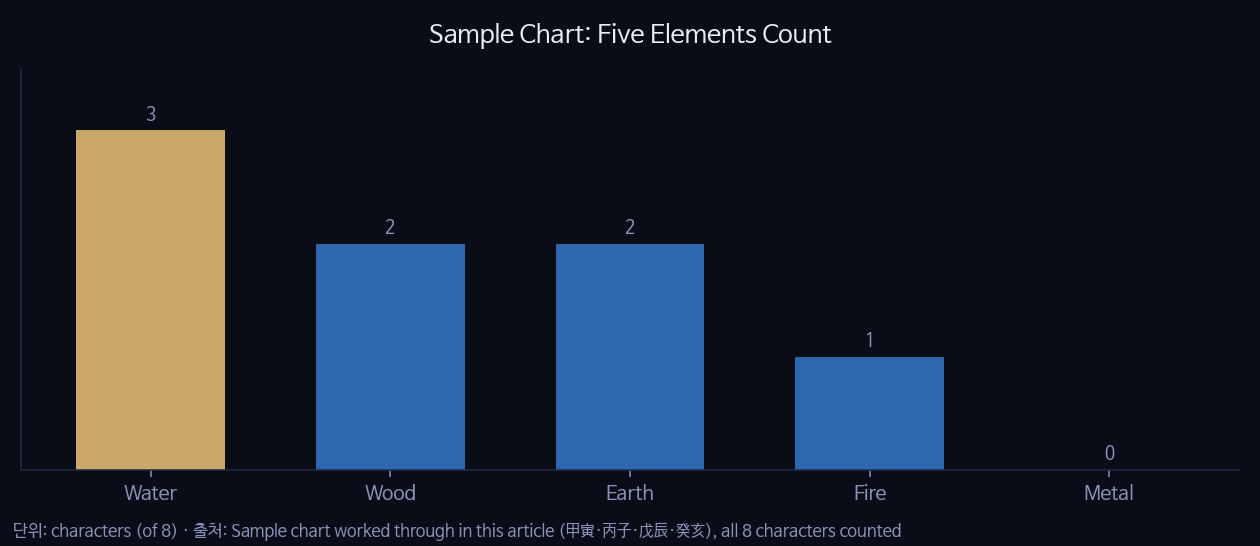
Step 3: Tally out of 8. Each character is worth 12.5% of the chart: Water 3 (37.5%), Wood 2 (25%), Earth 2 (25%), Fire 1 (12.5%), Metal 0 (0%). As a check, the five counts must add up to 8. Here, 3 + 2 + 2 + 1 + 0 = 8.
Step 4: Name the strongest, the weakest, and any zero. Water leads with 3 of 8 (37.5%), so wisdom (智) is the virtue most represented. Fire is the weakest element that still appears, at 1 of 8 (12.5%). Metal is at 0, so none of the 8 characters carries Metal.
Using the Cycles Without Overreading Them
Saju describes how elements relate through two cycles. The generating cycle runs Wood→Fire→Earth→Metal→Water→Wood, with each element feeding the next. The controlling cycle runs Wood→Earth→Water→Fire→Metal→Wood, with each element restraining the next.
In the sample chart, Water (3) feeds Wood (2), and Wood in turn feeds Fire (1). In the sample, Water (3) controls Fire (1), so the single Fire character sits under a much larger Water presence. Reading the cycles this way shows which elements support each other and which hold each other in check.
Traditionally, a chart is considered more favorable the more evenly its five elements are balanced. The sample, with Water at 3 and Metal at 0, is uneven, and that describes a tendency, not a verdict.
This 8-character count is a starting point. The month pillar begins at a solar term, not on the 1st of a calendar month, so the month can be misread if you go by the calendar date. Readings also look at hidden stems inside the branches. For example, 寅 holds 甲, 丙, and 戊. A simple tally of the 8 characters does not count hidden stems.
Signal Lab is an English-language Korean four-pillars fortune reading, with reaction and memory games. Try its K-Saju reading, and if your four pillars are shown, run the 4 steps above with the table.
Related free tool: Signal Lab — K-Saju fortune & brain games

댓글
댓글 쓰기