Heavenly Stems & Earthly Branches: Why Only 60 of 120 Pairs Exist
Ten Stems × Twelve Branches = One 60-Year Loop
Ten stems and twelve branches pair up to make exactly 60 combinations. The 61st year brings you back to the first pair. Each combination is called a *ganji*. The same pairs are attached to years, months, days and hours.
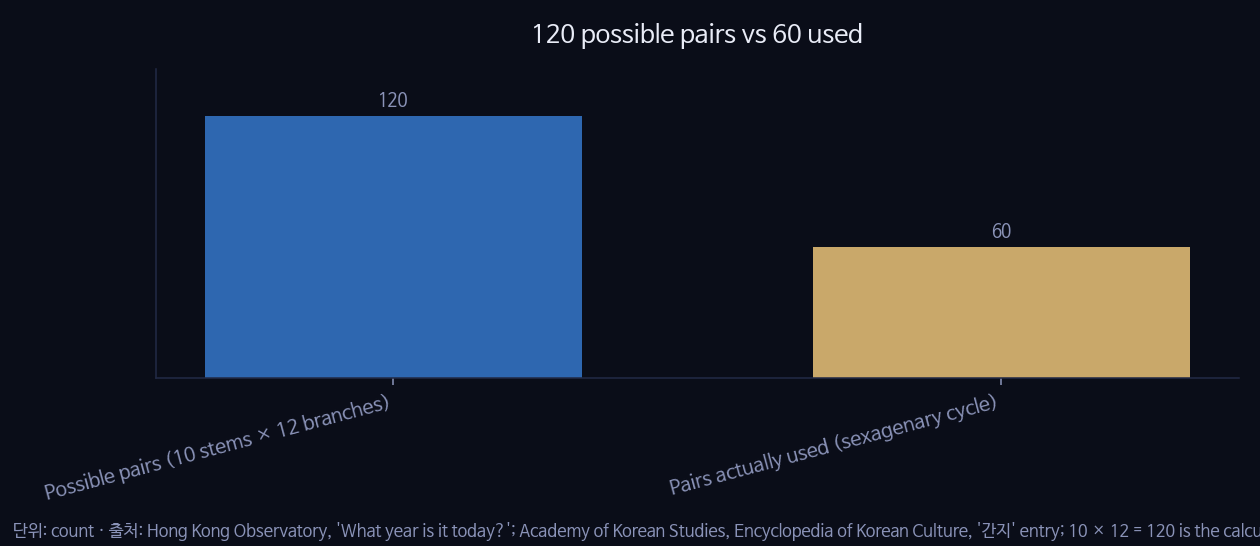
You might expect 10 × 12 = 120 pairs. Only 60 are ever used, because both lists move forward one step at a time, so odd-numbered stems always meet odd-numbered branches. Stem 1 meets branch 1, 3, 5 and so on, never branch 2. That halves the count to 60.
The same number comes out of the arithmetic. Stems repeat every 10 steps and branches every 12. The two lists line up again after 60 steps, the least common multiple of 10 and 12. The cycle starts at Gap-Ja, runs in order through Eul-Chuk, Byeong-In, Jeong-Myo and so on, and ends at Gye-Hae.
The 10 Stems, the 12 Branches, and the Five Elements
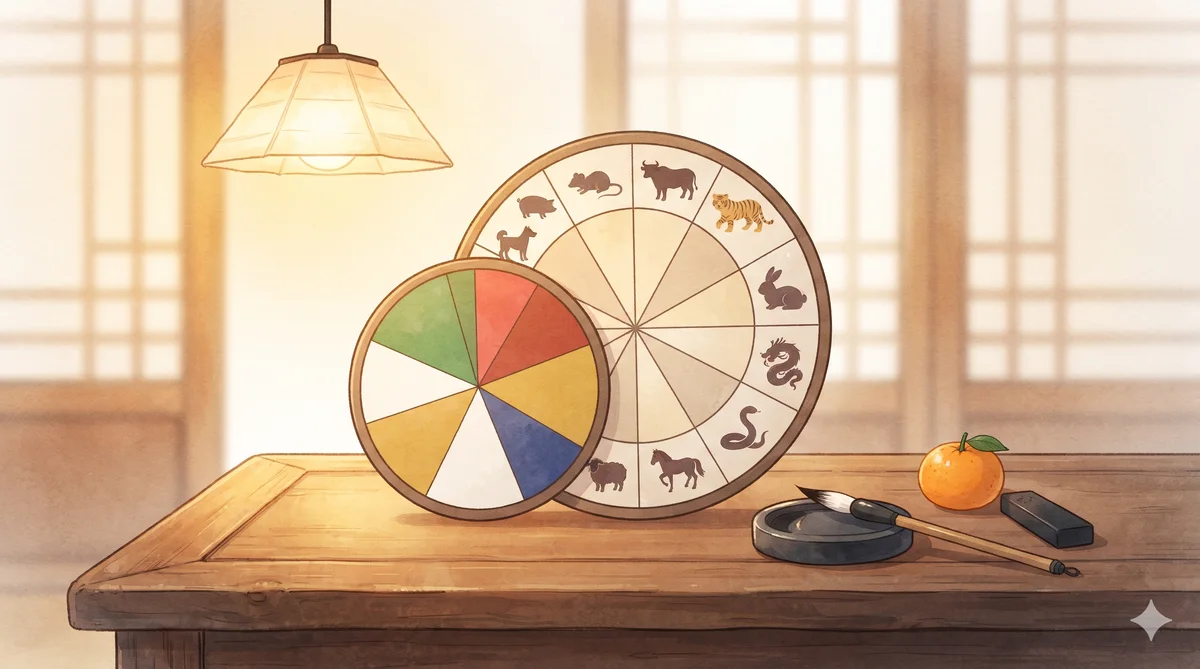
The ten stems run in this order: Gap, Eul, Byeong, Jeong, Mu, Gi, Gyeong, Sin, Im and Gye. They are grouped in pairs under the five elements: wood, fire, earth, metal and water.
The twelve branches run in this order: Ja, Chuk, In, Myo, Jin, Sa, O, Mi, Sin, Yu, Sul and Hae. They match the familiar zodiac animals: rat, ox, tiger, rabbit, dragon, snake, horse, sheep, monkey, rooster, dog and pig. Each branch also covers a two-hour slice of the day. Ja, for example, runs from 23:00 to 01:00.
Your zodiac animal shows only half of your pair. The branches began as a way to count years and hours in sets of 12, and the animals were added later. A complete year name needs the stem too. That is why "year of the horse" comes around every 12 years, while a particular horse year, such as Byeong-O, comes around every 60.
| Element | First stem | Second stem |
|---|---|---|
| Wood | Gap 甲 | Eul 乙 |
| Fire | Byeong 丙 | Jeong 丁 |
| Earth | Mu 戊 | Gi 己 |
| Metal | Gyeong 庚 | Sin 辛 |
| Water | Im 壬 | Gye 癸 |
One spelling trap is worth knowing. The eighth stem, Sin (辛, metal), and the ninth branch, Sin (申, monkey), share the same spelling but are different characters. Context tells you which one is meant.
Find Any Year's Pair in Two Divisions
1. Subtract 3 from the year. (This works because 2026 is a Byeong-O year, and 2026 − 3 = 2023 lands on the third stem and the seventh branch.)
2. Divide the result by 10. The remainder is the stem: 1 = Gap, 2 = Eul, 3 = Byeong, 4 = Jeong, 5 = Mu, 6 = Gi, 7 = Gyeong, 8 = Sin, 9 = Im, 0 = Gye.
3. Divide the same result by 12. The remainder is the branch: 1 = Ja, 2 = Chuk, 3 = In, 4 = Myo, 5 = Jin, 6 = Sa, 7 = O, 8 = Mi, 9 = Sin, 10 = Yu, 11 = Sul, 0 = Hae.
A remainder of 0 means the last item in the list: Gye for the stems, Hae for the branches.
Take 2026. Subtracting 3 gives 2023. Dividing 2023 by 10 gives 202 with a remainder of 3, and the third stem is Byeong, a fire stem. Dividing 2023 by 12 gives 168 with a remainder of 7, and the seventh branch is O, the horse. So 2026 is Byeong-O (丙午), the fire horse year.
To check the loop, add 60 and try 2086. Subtracting 3 gives 2083, which leaves a remainder of 3 when divided by 10 and 7 when divided by 12. The result is Byeong-O again. For a zero case, 2013 − 3 = 2010, which leaves 0 (Gye) and 6 (Sa): Gye-Sa.
One caution applies to birth years. In fortune-telling practice, the new year begins at *Ipchun*, the start of spring, not on 1 January or Seollal (Lunar New Year). Someone born after Seollal but before Ipchun takes the previous year's pair. The Korea Astronomy and Space Science Institute's 2026 solar-term table puts Ipchun at 05:02 on 4 February; the institute notes its official figures appear in its annual almanac. For other years, look up that year's Ipchun date if your birthday falls between 1 January and early spring. A birth date of 20 January 2026 still counts as 2025: 2022 ÷ 10 leaves 2 and 2022 ÷ 12 leaves 6, which gives Eul-Sa.
From Hwangap to Four Pillars: Where the Cycle Shows Up
The 60-year loop shows up in two parts of Korean life. The first is *hwangap* (also *hoegap* or *jugap*), the 60th birthday. After 60 years, the year pair of your birth comes around again. 1966 was a Byeong-O year, and 60 years later 2026 is Byeong-O again. Korean counting calls that age 61, but in international age it is the 60th birthday.
The second is *saju*, meaning "four pillars." The four pillars are the year, month, day and hour of birth, and each one is written as a ganji pair. That makes eight characters in all, so saju is also called *palja*, "eight characters." One Korean reference gives this example: a person born at 6 p.m. on 25 August 1911 has the pillars Sin-Hae (year), Byeong-Sin (month), Jeong-Myo (day) and Gi-Yu (hour). The month pillar also changes with the solar terms, not on the 1st of the calendar month.
You can work out the year pillar by hand with the two divisions above. The other three pillars need date tables, because the month and hour pillars follow solar terms and two-hour slots. Signal Lab offers a K-Saju reading in English that sets out the four pillars from a birth date and time, so you can compare them with the year pair you worked out by hand. It also has reaction and memory games.
Related free tool: Signal Lab — K-Saju fortune & brain games

댓글
댓글 쓰기