Number Bonds to 10: Why 6 Pairs Make Addition So Much Easier

Learn the Pairs That Make 10 First, Then Add
A child who knows every pair that makes 10 can solve 8 + 5 in two steps. A child who doesn't has to count on five times from 8. Korea's math curriculum lists splitting and combining numbers before the standards on addition and subtraction.
A number bond shows how one number breaks into two parts. The whole sits on top and the two parts sit below it. For 10 = 7 + 3, it looks like this:
```
10
/ \
7 3
```
This reads as 10 = 7 + 3. The whole is 10, and the parts are 7 and 3.
Bonds come before addition drills for one reason. A drill asks for speed. Speed only works if the child already sees that 10 is made of two parts. Korea's 2022 elementary math curriculum for grades 1 and 2 follows this order. The standard on splitting one number into two and combining two numbers into one is listed before the standards on the meaning of addition and subtraction and on calculating with two-digit numbers. Korean classrooms call this activity "splitting and combining." The curriculum keeps it to numbers of 20 or less. The same curriculum asks teachers to let children calculate in several ways and not to make addition too formal.
England's official guidance says the same thing in its own words: pupils should learn to compose and partition numbers within 10 before moving on to formal addition and subtraction. It adds that putting parts together to make a whole is the base of addition, and that splitting a whole is the base of subtraction.
Every Number Bond to 10 in One Table
There are 11 ordered pairs that make 10, but only 6 unique ones. Here are the 6.
| Number | Partner to make 10 | Bond written out |
|---|---|---|
| 0 | 10 | 0 + 10 = 10 |
| 1 | 9 | 1 + 9 = 10 |
| 2 | 8 | 2 + 8 = 10 |
| 3 | 7 | 3 + 7 = 10 |
| 4 | 6 | 4 + 6 = 10 |
| 5 | 5 | 5 + 5 = 10 |
Each row except the last also has a reversed pair: 10 + 0, 9 + 1, 8 + 2, 7 + 3 and 6 + 4. Those five plus the six above make 11. The Korean curriculum asks teachers to let children swap two single-digit numbers, as in 3 + 7 = 7 + 3, and see that the answer stays the same. England's guidance adds that this swap cuts down the number of facts a child has to memorise. So a child only has to learn 6 bonds, not 11. Only 5 + 5 has no reverse, because both parts are equal.
The table also shows a pattern. Each time the first number goes up by 1, its partner goes down by 1, and the two always add to 10. A child who knows 4 + 6 = 10 can get 5 + 5 by moving one from the 6 to the 4.
How Making 10 Turns Hard Sums into Easy Ones
Making ten means breaking the second number so the first one reaches 10, then adding what is left. Take 8 + 5. The 8 needs 2 more to reach 10, so split 5 into 2 and 3. Then 8 + 2 = 10, and 10 + 3 = 13.
Now try 7 + 6. The 7 needs 3, so split 6 into 3 and 3. Then 7 + 3 = 10, and 10 + 3 = 13.
The same steps work when the first number is close to 10 or far from it. In 9 + 4, the 9 needs 1, so split 4 into 1 and 3, and 10 + 3 = 13. In 6 + 8, the 6 needs 4, so split 8 into 4 and 4, and 10 + 4 = 14.
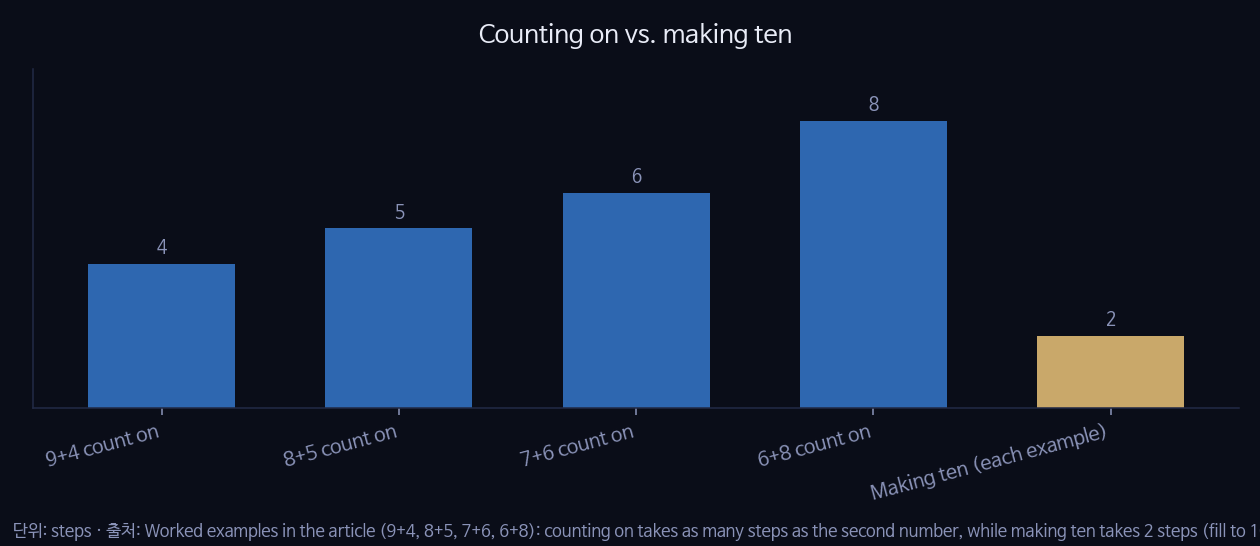
Now compare the effort. Counting on from the first number takes 5 counts for 8 + 5, 6 counts for 7 + 6, 4 counts for 9 + 4 and 8 counts for 6 + 8. Making ten takes 2 steps every time: fill up to 10, then add the rest. The longer the count, the more this saves. In 6 + 8, that is 8 counts against 2 steps. The US Common Core standards list both counting on and making ten as strategies for sums within 20. Their own example is 8 + 6 = 8 + 2 + 4 = 10 + 4 = 14. England's Year 2 guidance suggests ten-frames (two rows of five boxes) and splitting pictures to practice this step.
The idea also works with three numbers. In 7 + 3 + 2, add the pair that makes 10 first, then the leftover: 10 + 2 = 12. The Korean curriculum asks children to compare this order with simply adding from left to right, so they see that both give 12. Try 4 + 8 + 6 the same way: 4 + 6 = 10, then 10 + 8 = 18. Adding left to right gives 4 + 8 = 12, then 12 + 6 = 18, which is the same answer but a harder middle step.
The bond also runs backward for subtraction. For 13 − 5, take away 3 to land on 10, then take away the other 2 from 5: 13 − 3 = 10, and 10 − 2 = 8.
A Simple Daily Routine at Home
Keep each session short and stop while the child still wants to continue. Move to the next step only when the current one feels easy.
1. Objects. Put 10 coins or buttons on the table. Slide some to one side and ask, "How many are left?" Try every split from 0 and 10 to 5 and 5. If 4 slide over, 6 stay.
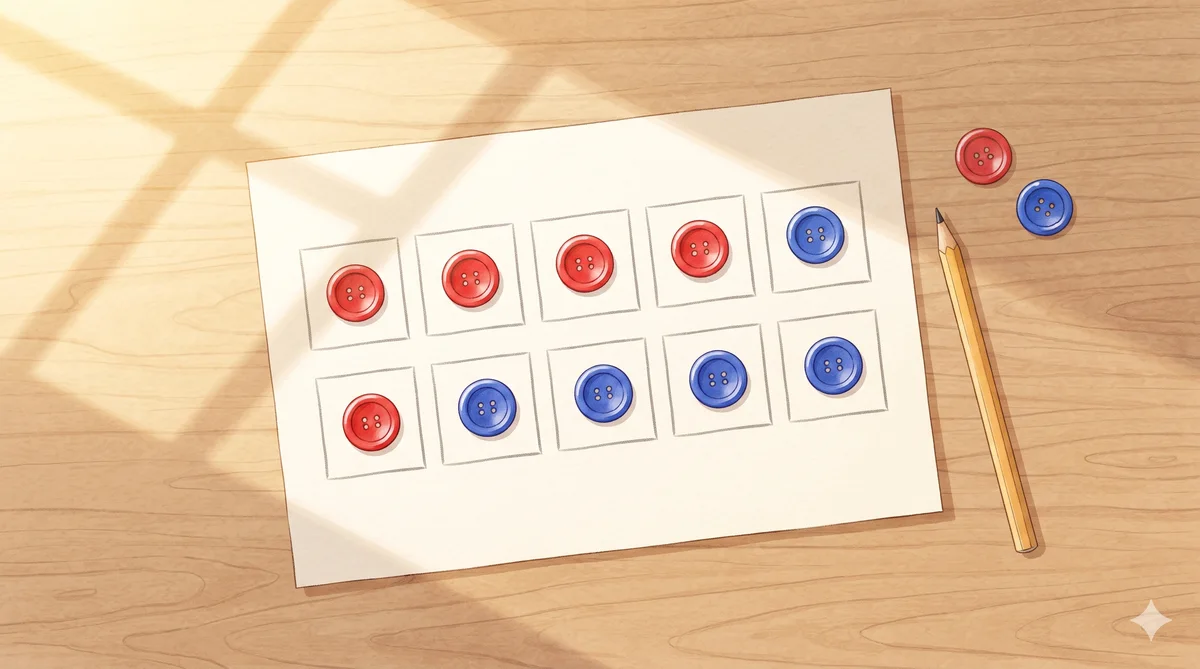
2. A 10-frame. Draw two rows of five boxes on paper. Place 7 buttons in the boxes and ask how many empty boxes remain. The answer is the partner, 3.
3. Saying pairs aloud. Say a number and let your child answer with its partner. "Six." "Four." Mix the order so it isn't a fixed chant. A run such as 2, 9, 5, 7, 1 should get 8, 1, 5, 3, 9.
4. Written bonds. Write 6 + __ = 10 and let your child fill the blank. Then try 8 + 5 with the make-ten steps.
England's guidance says to keep teaching and practising until a child recalls the facts within 10 without counting by ones. To check, call out numbers from 0 to 10 in random order and see whether each answer comes straight away. If any answer needs counting, stay with steps 1 to 3 and test again later with new numbers.
Printable worksheets belong at the written stage. The operator's grade-by-grade arithmetic worksheets in the Korean method give written practice once the bonds are secure. They add to the hands-on work in steps 1 to 3 and don't replace it.
Related free tool: Free printable Korean-style math drills

댓글
댓글 쓰기