Two Digit Addition With Regrouping: Why 45 of 100 Pairs Carry
Carry Only When the Ones Add Up to 10 or More
Regrouping and carrying mean the same thing. When the ones column adds up to 10 or more, you trade 10 ones for 1 ten and move that ten to the tens column. This article uses "carry" from here on. The test is one question: is the ones sum 10 or more?
- 7 + 8 = 15. That is 10 or more, so you carry.
- 3 + 4 = 7. That is 9 or less, so nothing moves.
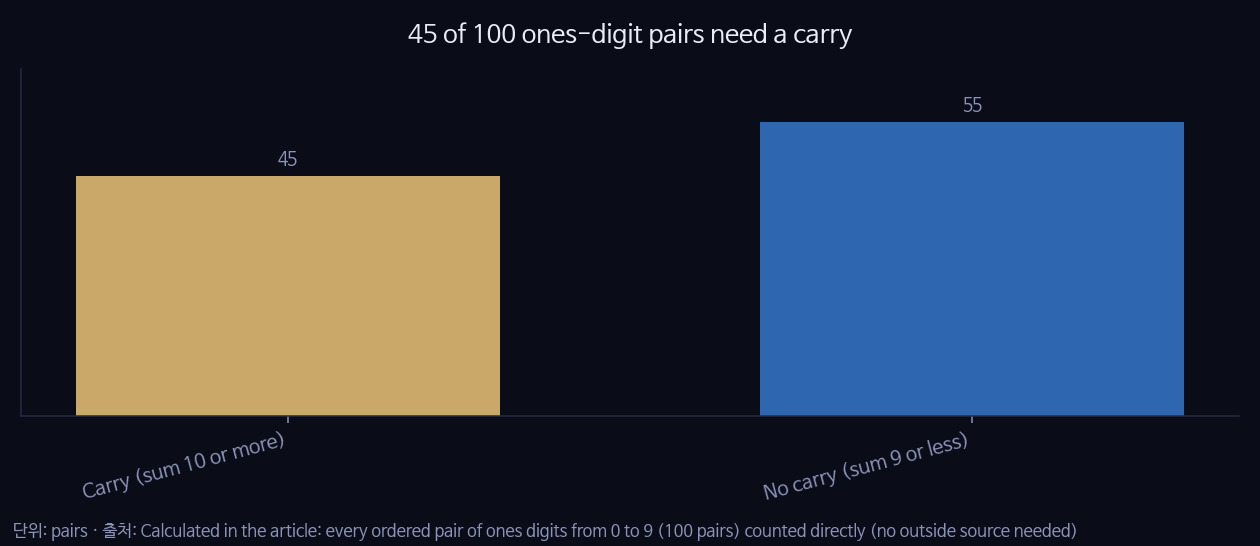
Take every pair of ones digits, 0 to 9 for each. That gives 100 pairs. Of these, 45 add up to 10 or more and 55 do not. The 45 comes from counting: a pair with a ones digit of 1 has 1 partner that reaches 10, a digit of 2 has 2 partners, and so on up to 9 with 9 partners. Adding these gives 1 + 2 + … + 9 = 45. Almost half of all ones-digit pairs need a carry, so a child who has only practiced the no-carry kind has met just 55 of the 100 possible pairs.
Common Core standard 1.NBT.C.4 says the same thing in its own words: when adding two-digit numbers, "sometimes it is necessary to compose a ten." "Compose a ten" is the standards' name for carrying, and the word "sometimes" matches the count above.
The 4-Step Column Method, Worked Through 47 + 38
Have your child say each step out loud. Standard 1.NBT.C.4 asks students to relate the strategy to a written method and explain the reasoning used, and speaking each step is the simplest way to do that at the kitchen table. Standard 2.NBT.B.9 goes one step further for Grade 2 and asks students to explain why an addition strategy works, using place value.
Step 1: Line up the columns. Write 47 above 38 so the 7 sits over the 8 and the 4 sits over the 3.
Child says: "Ones under ones, tens under tens."
Step 2: Add the ones. 7 + 8 = 15.
Child says: "Seven plus eight is fifteen. That is more than nine, so I carry."
Step 3: Write the 5 and carry the ten. Put 5 in the ones place of the answer. Write a small 1 above the tens column, over the 4. The 1 stands for 10, one bundle of ten ones, which is why it belongs in the tens column. Standard 1.NBT.B.2a describes the same idea: 10 can be thought of as a bundle of ten ones, called a "ten."
Child says: "Fifteen is one ten and five ones. I write the five and carry the ten."
Step 4: Add the tens. 4 + 3 + 1 = 8. Put 8 in the tens place.
Child says: "Four plus three plus the one I carried is eight."
The answer is 85.
Try a second problem with the same steps: 36 + 48. The ones are 6 + 8 = 14, so write 4 and carry the small 1. The tens are 3 + 4 + 1 = 8. The answer is 84. When a child can predict "carry" before adding, the method has settled.
Three Column Mistakes and How to Spot Them in the Answer
Each wrong answer for 47 + 38 has a shape that gives away the mistake. Look at the answer before you look at the work.
| Mistake | Wrong answer for 47 + 38 | What happened | Quick fix |
|---|---|---|---|
| Writing the whole 15 in the ones place | 715 | 4 + 3 = 7 was written next to 15, and nothing was carried | One box holds one digit |
| Forgetting the carried 1 | 75 | The tens were added as 4 + 3 = 7, without the 1 | Read the tens aloud as "4 + 3 + 1" |
| Adding the carry twice | 95 | The tens were added as 4 + 3 + 1 + 1 | Circle the small 1 right after you add it |
| Correct method | 85 | Write 5, carry 1, then 4 + 3 + 1 = 8 | Compare with the estimate of 90 |
An answer with three digits is a red flag here. Two two-digit numbers add up to at most 99 + 99 = 198, and 47 + 38 is far below that, so 715 cannot be right. If the answer is exactly 10 less or 10 more than 85 (75 or 95), the carried 1 was skipped or added twice. Ask your child whether the small 1 was added, and whether it was added only once.
An estimate catches slips before you even read the work. Round 47 up to 50 and 38 up to 40. Then 50 + 40 = 90, so the real answer should land close to 90. An answer of 85 passes. An answer of 715 fails at once. An answer of 95 is 5 away from 90 and 75 is 15 away, so the estimate alone will not settle them. For those, check the tens digit against 4 + 3 + 1 = 8.
Practice Plan With Printable Worksheets
Start with problems that have no carry, such as 23 + 41, so the column habit settles first. Your child lines up the digits, adds the ones (3 + 1 = 4), then adds the tens (2 + 4 = 6), and writes 64. Once the placement is steady, add problems where the ones sum is 10 or more, such as 47 + 38. Then put both kinds on one page.
Make the page about half of each, with 34 + 25 (no carry) next to 47 + 38 (carry). Before each problem, your child checks the ones digits and says "carry" or "no carry" out loud. If the problems are sorted by type, a child can carry on autopilot without checking.
Next, add the estimate. Before adding, your child writes a rounded sum beside the problem, as with 50 + 40 = 90 for 47 + 38. After solving, they compare the two numbers. An answer far from the estimate gets rechecked with the table above.
The operator offers free printable arithmetic worksheets, sorted by grade, in the Korean method and written in English. Pick the sheet for your child's grade, print it, and use it in short sessions with the four steps above. In US Common Core states, 2.NBT.B.5 asks Grade 2 students to add and subtract fluently within 100; other school systems may place this differently, so check that the sheet you pick includes two-digit addition.
Related free tool: Free printable Korean-style math drills

댓글
댓글 쓰기